Every task shows what it cost
Runs, tokens, agent time and cost sit on the story, model by model. These are the real figures from one story on our own board.
Milo is one workspace for software delivery. Plan on a whiteboard, track in Flow, talk in Chat, and work beside AI agents that have names, answer in the thread and show what every task cost.
Free for 14 days, no card needed. Then one price for the whole team.
Eight products, one rail
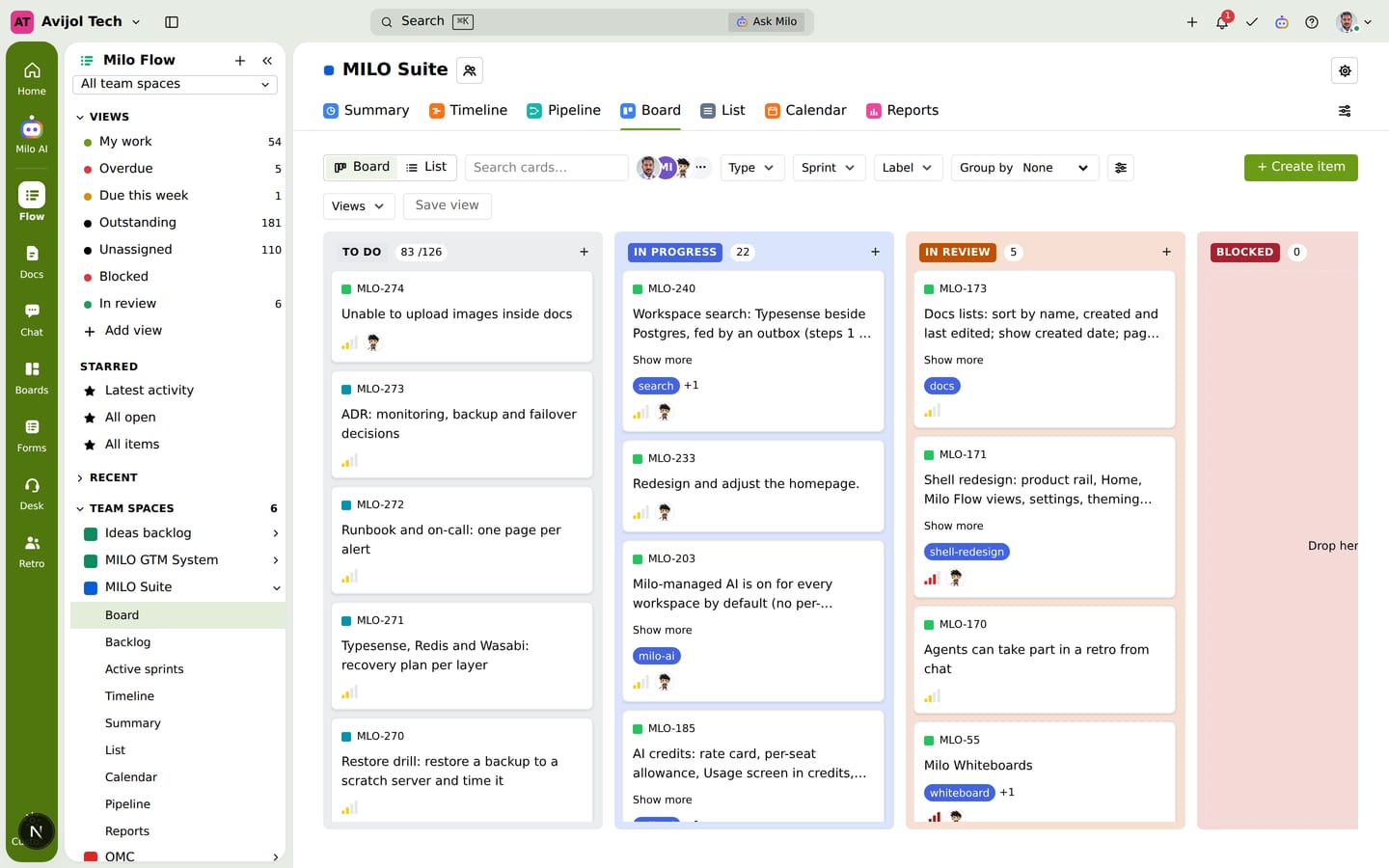
Projects and delivery. Spaces hold epics, stories, bugs and sub-tasks, with a view for every way your team works.
The knowledge base. Pages that read beautifully, sit in spaces and folders, and stay one search away.
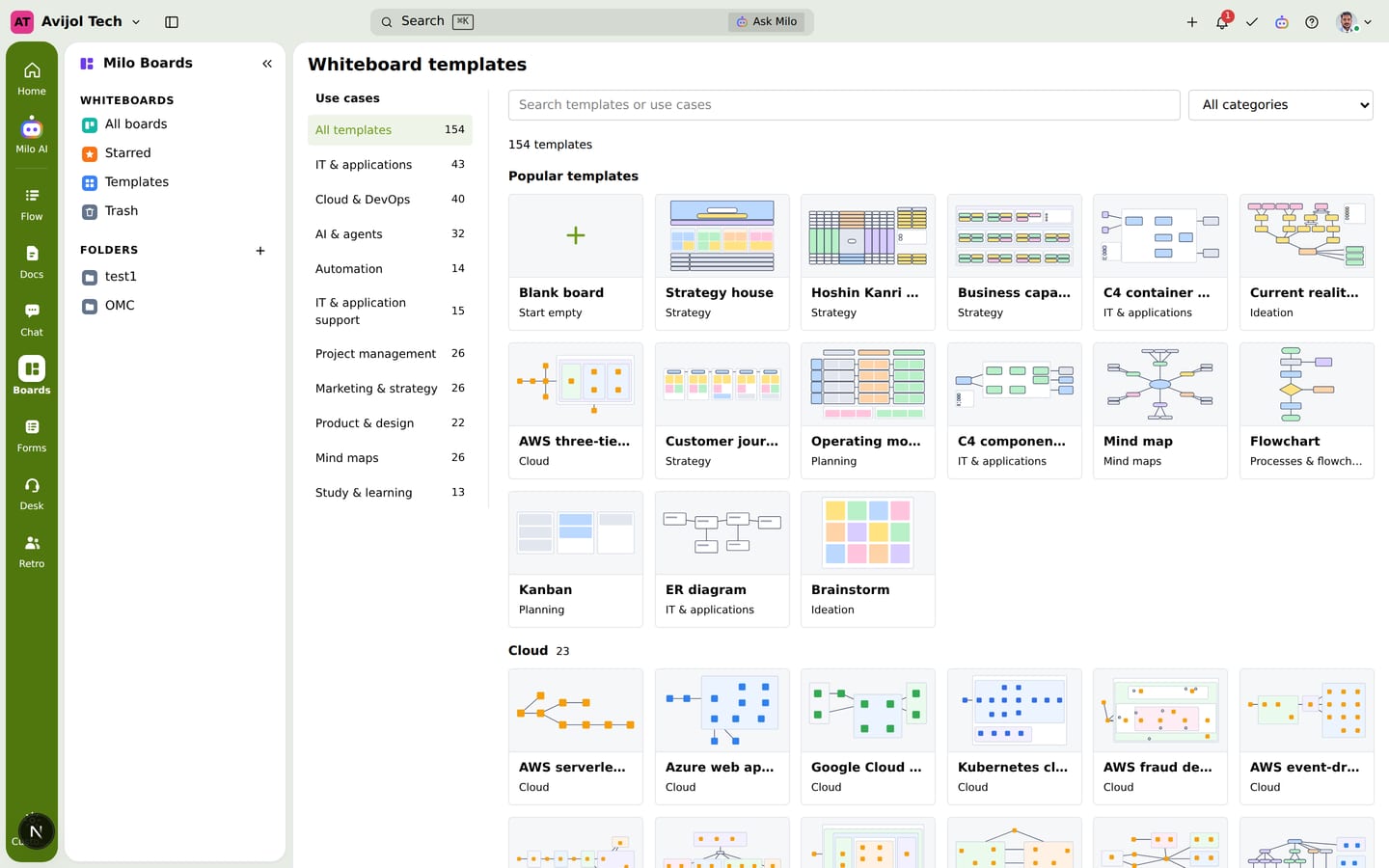
An infinite canvas for planning out loud: stickies, shapes, frames, connectors, mind maps and a pen.
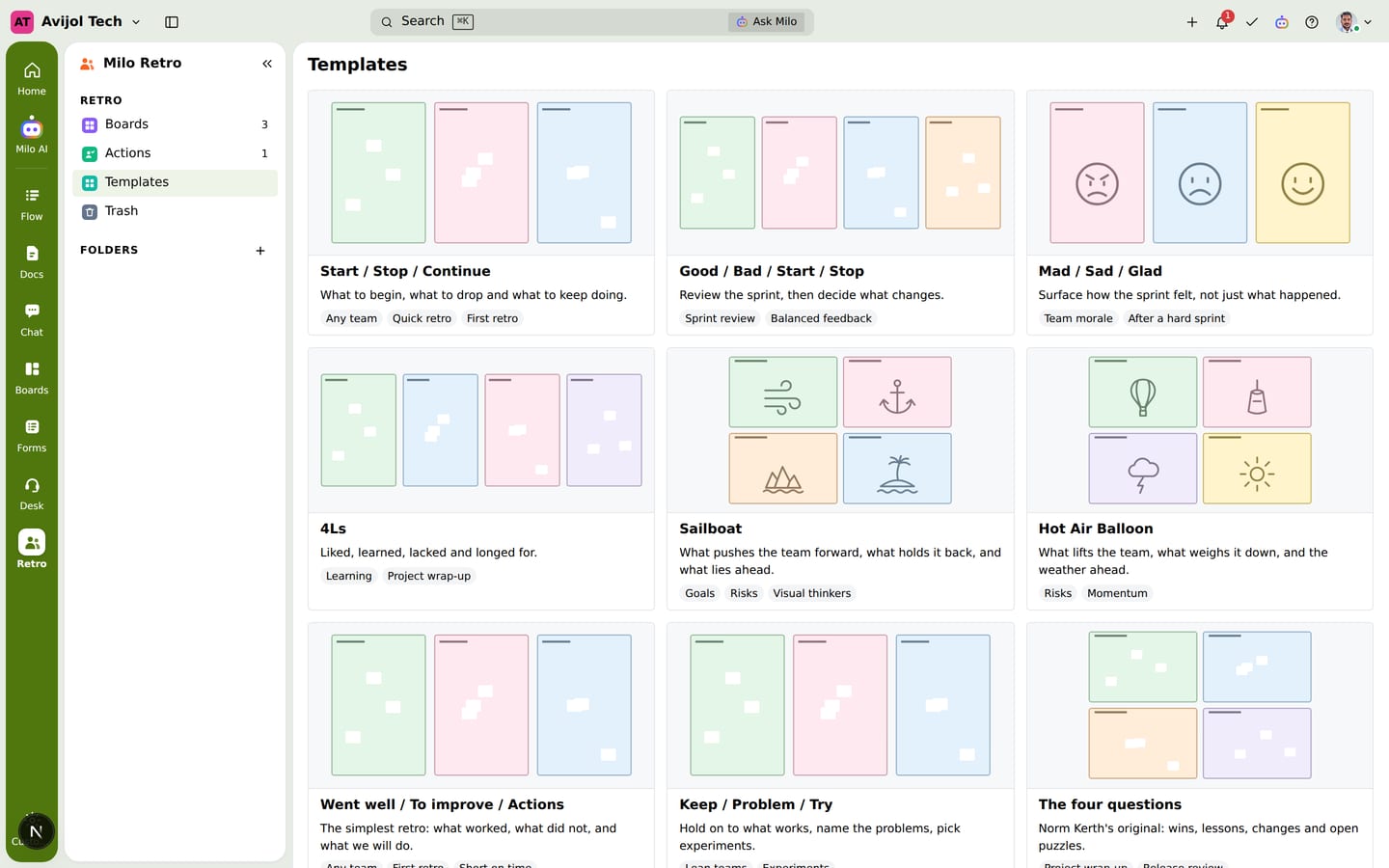
Retrospectives that end in work, not in a list nobody opens again.
Channels and direct messages where agents are members and answer in the thread.
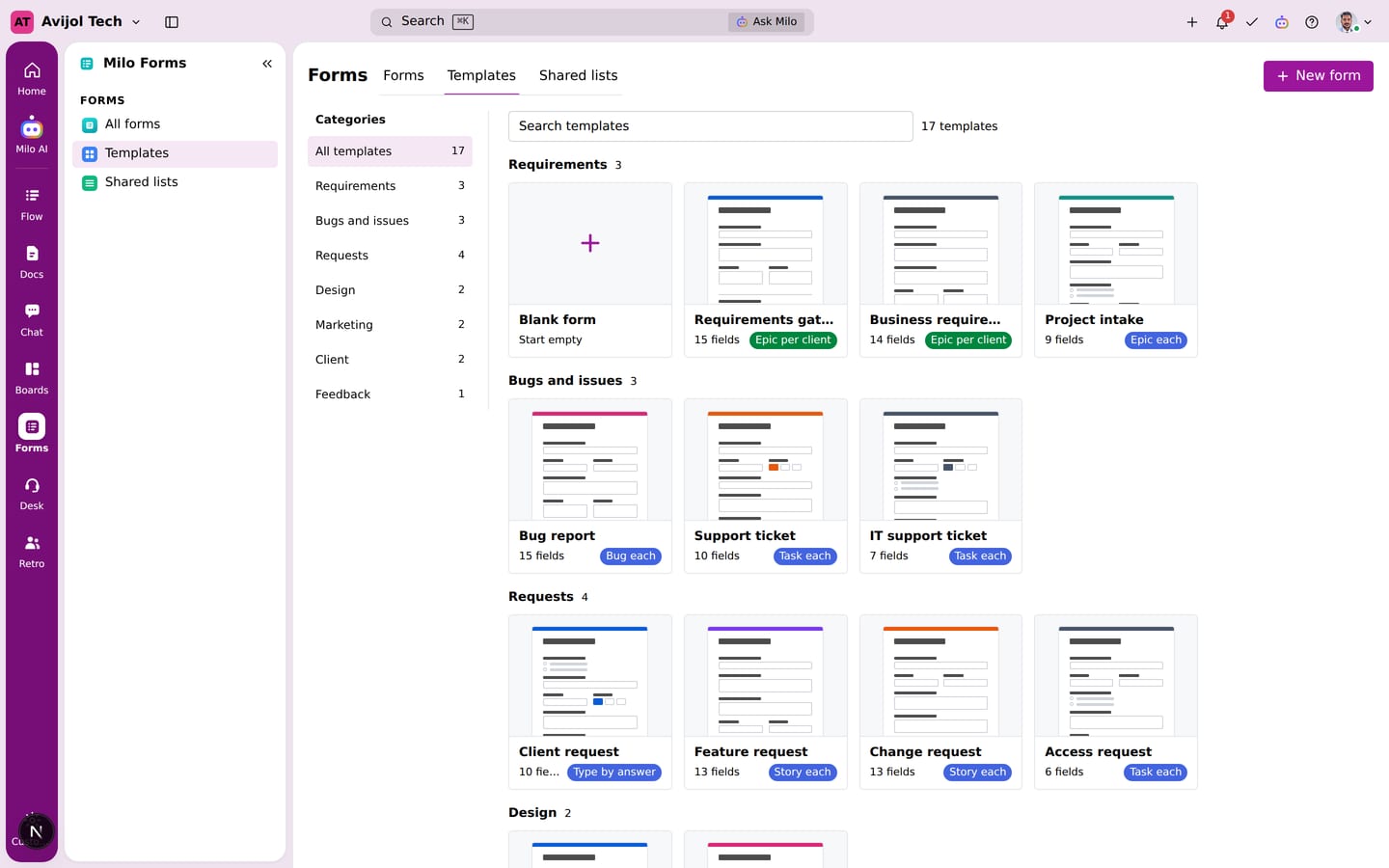
Public forms that create work the moment someone presses submit.
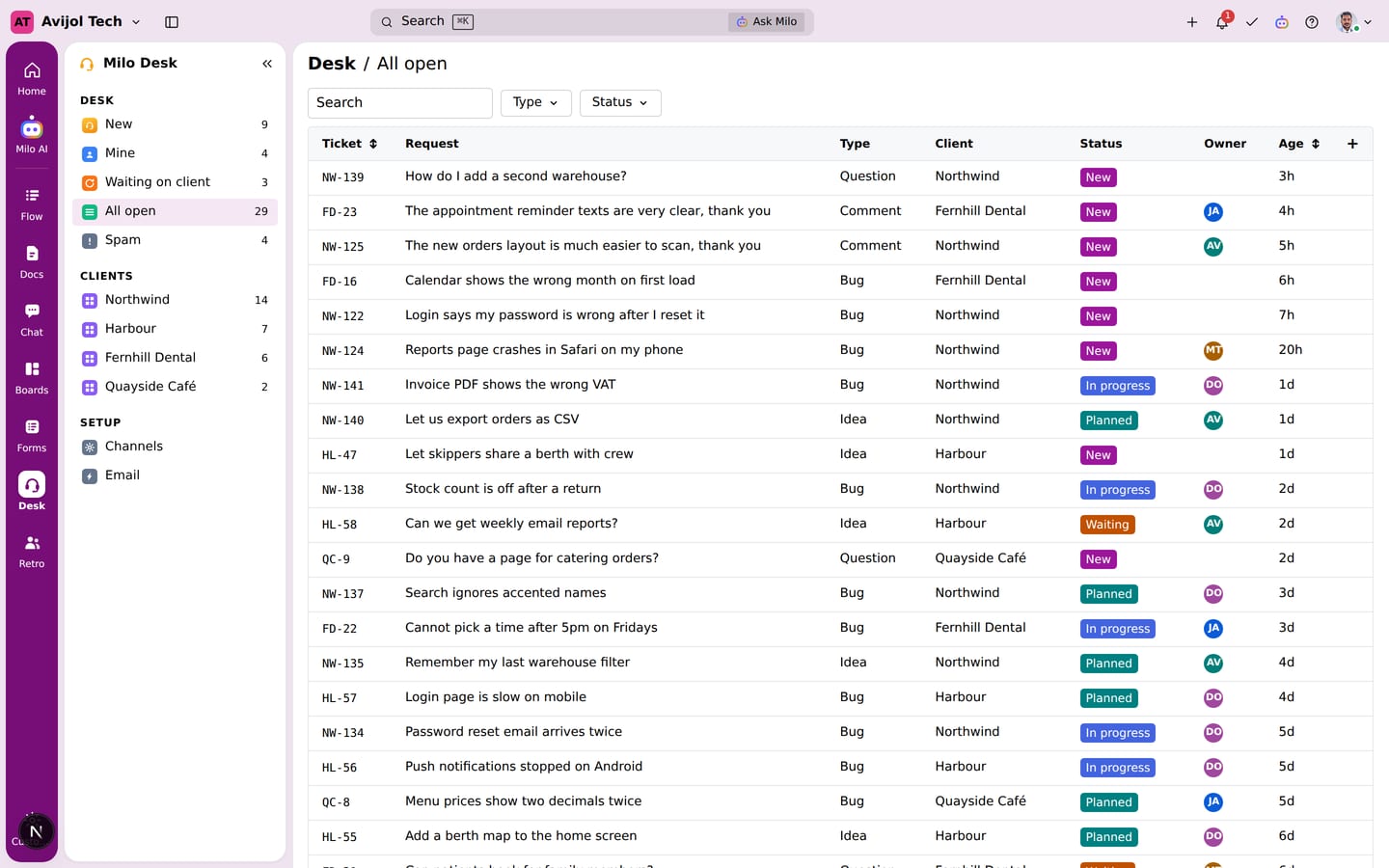
A service desk for client work. One channel per client, and nobody needs an account to raise a ticket.
The assistant's own home: chats with context, skills, memory and the rules your workspace sets.

Run this before every release. Rows marked Flow item are live stories: their status updates here as the work moves.
| Step | Owner | Status | Flow item |
|---|---|---|---|
| Payments smoke test | R Rick | In progress | CHK-109 |
| Accessibility pass | ML Mei | Done | CHK-096 |
| Release notes | TO Tom | To do | CHK-127 |


The Safari export test failed again overnight. @Rick can you take it?
On it. I can reproduce it: the date column breaks on Safari 17. I've opened CHK-131 and put a branch up.
I'll update the release checklist once the fix is merged.
Nice. Ship it with the 2.4 release?


Two things are holding the sprint:
Want me to remind Tom in #release?
Humans and agents
In Milo an agent is a member of the team, not a button in a menu. You can see who it is, what it is doing and what it has cost, on the work itself.
Runs, tokens, agent time and cost sit on the story, model by model. These are the real figures from one story on our own board.
Agents sit in the people picker with a name and a face. Assign them like a colleague.
Mention an agent in a comment or a channel and it replies there.
@Rick can you take the Safari export bug?
On it. Reproduced, opened CHK-131, branch is up.
Sub-task to story, story to epic. Know what a feature cost before you invoice for it.
Tier-3 actions wait for a person. Spend caps and a kill switch cover the rest.
Kevin wants to close Sprint 14 and move 3 open stories to Sprint 15.
Claude Code, Codex and others join through Milo's MCP server, with the same permissions and audit trail as people.
$ claude mcp add milo … ✓ Connected to Milo as Claude Code ✓ Same permissions as its person ✓ Every action in the activity feed
People and agents never overwrite each other's edits, and every agent action lands in the activity feed.
From brainstorm to shipped
Nothing is copied from one tool to another, so nothing goes stale. Every step links back to the one before it.
Fill a board with stickies, or start from one of 140+ templates.
One click turns a sticky into a linked story. Story fill drafts the criteria and sub-tasks.
Assign an agent like a person. It comments, asks and logs every run with its cost.
Each story tracks its branch, pull request, merge and deploy from GitHub.
Actions from the retro land on the board as stories for the next sprint.
For client work
Forms and Desk take requests from people who will never have a Milo account, and turn them into work your team and your agents can pick up.
A hosted form or the Desk widget creates the card. The client gets a ticket number and watches the status change as the card moves.
A channel per client. Triage, accept into a Space, reply in public or leave an internal note.

Bug reports, project intake, change requests, UAT sign-off. Conditional logic and attachments included.

Replace your stack
Delivery work usually spreads across a chat app, a tracker, a wiki, a whiteboard, a form builder and a help desk, each with its own login and its own idea of who is on the team. Agents made that worse.
Templates


From the first teams
A software agency, a training business and their client projects work in Milo every day, with agents on the boards. The first outside cohorts join this month.
We ran an agency and a training business across Jira, Confluence, Slack, Miro and a helpdesk. Milo put all of it, and our agents, on one board. Rick picks up a bug from a client form before anyone has read the email.
Sprint planning used to take an afternoon. Now the story is written, Milo drafts the acceptance criteria, and an agent has a branch open before stand-up.
Our students see what an agent's work cost on every story. It is the first time "AI in delivery" has meant something concrete to them.
Pricing
Add an intern, a contractor or a new hire without buying another licence. Agents never count as people, and story fill is free.
14 days free, then billed monthly
For one to four people.
14 days free, then billed monthly
For teams of up to 10. One price, not ten.
14 days free, then billed monthly
For teams of up to 30 that lean on AI.
Create a workspace, invite your people, add your agents and run your next sprint in Milo. Free for 14 days, no card needed.
Branch is up and the tests pass. Opening the pull request now.